Better Decision-Making
Identify with certainty what truly resonates, eliminating cognitive biases to predict performance. Democratizing decision-making through empirical evidence.
"We turn human behavior and data into content decisions."
Médano Network is a consulting firm in behavioral science, psychology, neuroscience, user research and UX. We extract data, analyze performance and design systems that improve retention, engagement and monetization for creators, MCNs and content companies. We do not produce videos — we research, measure and design frameworks based on evidence.
or email us at medano.network@gmail.com
MEDANO Content Capability System™
Vertical 9:16 Production
Professional Architecture
Monetization & Operations
Content Research
Knowledge Transfer
For Global Platforms
Creator recruitment, behavioral audience research and localized production for Chinese and US platforms expanding into Latin America.

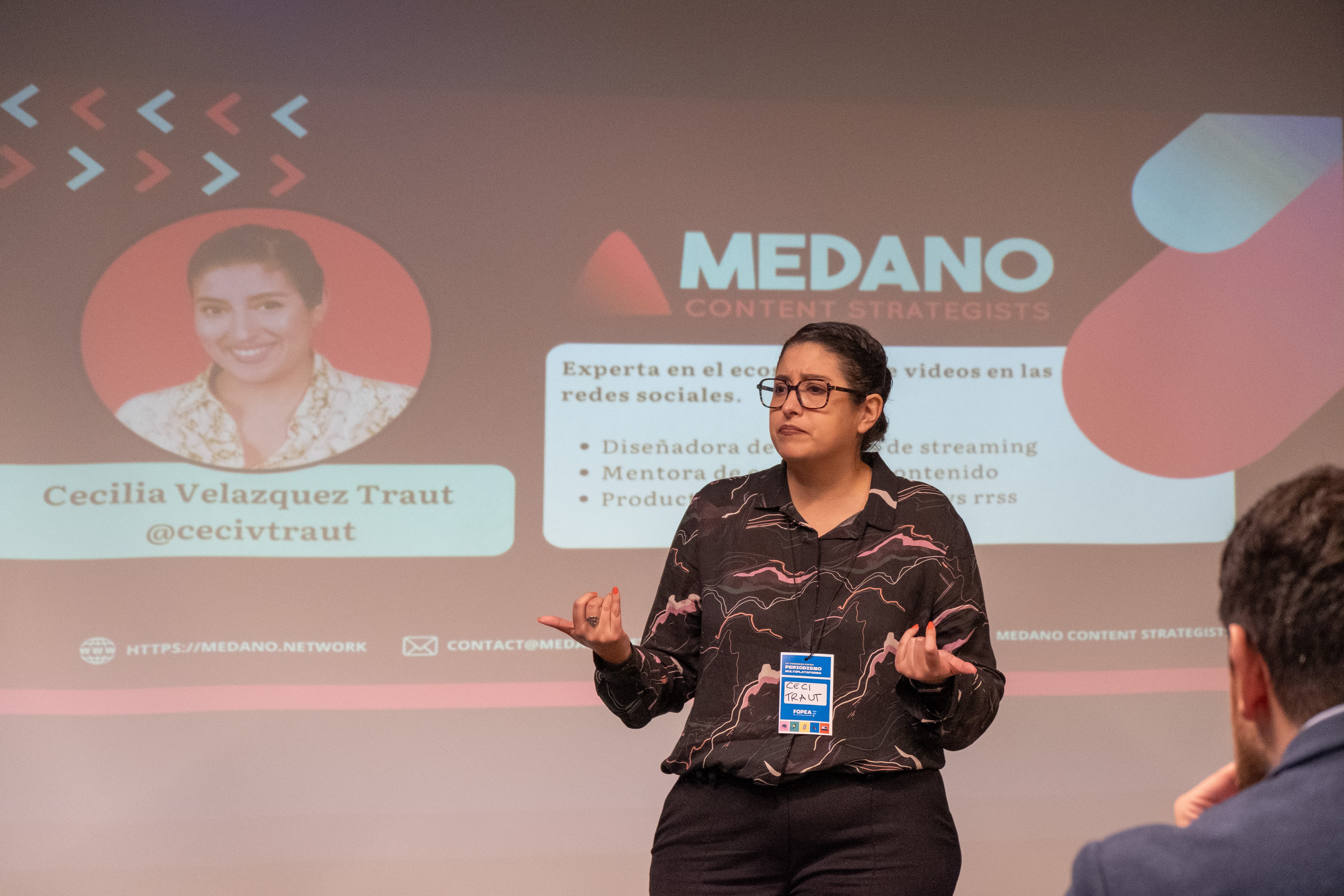
Cecilia Velazquez Traut is the strategist who translates human behavior and data into content decisions. With over 20 years of experience, she extracts data, analyzes performance and applies behavioral science, psychology, neuroscience and UX research to design systems that improve retention, engagement and monetization. She is not a video producer or a creative agency: her work is research, measurement and framework design. Médano Network is the consulting practice built around that discipline.
MEDANO / IN ACTION





Turnkey solutions for professional streaming environments, from acoustic treatment to professional-grade PTZ cameras and broadcast software configuration.
Content management, distribution, content and market research, and product development.
System VQB (Video Quality Booster): Data-driven growth, AI automation pipelines, and multi-monetization strategies for short-form video on TikTok, YouTube Shorts, and Instagram Reels.
Long-term organic content planning and original audiovisual funnel development for brands and creators.
Applying cognitive biases and behavioral economics principles to design content that maximizes audience retention and conversion.
Your strategic gateway to the LATAM creator economy, connecting global platforms with creators, audiences, and market opportunities.
METHODOLOGY & INNOVATION
Most brands and creators remain trapped in repetitive production without validation. At Médano, we treat content as a living system: transforming assumptions into testable hypotheses, de-risking investments, and scaling only what proves authentic audience traction.
Growth hacking is not about throwing ideas against the wall as fast as you can to see what sticks. It's about applying rapid experimentation to find and then optimize the most promising areas of opportunity.
The most powerful thing we can control is how much we learn and how fast we apply our learnings to adapt to change. If we deploy more successful experiments than our competitors, we will learn more, better hone our growth process and grow faster.
Our success at Amazon is a function of how many experiments we do per year, per month, per week, per day.
Identify with certainty what truly resonates, eliminating cognitive biases to predict performance. Democratizing decision-making through empirical evidence.
Channel resources directly into high-value initiatives. Test small, learn fast, and scale only what is empirically validated.
Foster a curious and agile organization. Redefine failure: early negative results are simply data points that refine the overall way of work.
Experiments per year run by industry leaders (Booking, OpenAI). Sustainable performance is not luck: it is learning architecture.
Organizations with standard talent can achieve extraordinary performance through the right organizational design and incentive alignment.
A premium group mentorship program and professional community for creators and MCN owners. Grow with clear strategies, multi-monetization frameworks, and real peer support—not just luck.
The consulting pushed us to create more content, and that resulted in an effort that paid off. We learned the importance of balancing quantity and quality in our content. It was a growth process that we truly appreciated.
Ramiro Andrés
Carlos Devis
It is the discipline that uses psychology, neuroscience and behavioral economics to understand why people watch, share, drop off or convert in front of a piece of content. Applied to digital content, it identifies the cognitive biases and motivations that govern attention and retention, and translates that knowledge into measurable decisions: which formats, narrative structures and triggers improve the real performance of a video or a piece.
We analyze behavioral data —retention curves, drop-off points, interaction patterns— and interpret it with frameworks from psychology and neuroscience: cognitive load, selective attention, reward and anticipation. With that reading we design hypotheses about what drives retention and conversion, test them with controlled experiments and keep the changes that the evidence confirms. The result is a system of continuous improvement, not a creative hunch.
Making content is producing pieces; designing performance systems is building the research, measurement and decision process that makes each piece perform better than the last. Médano does not position itself as a producer: we extract data, apply behavioral science and design repeatable frameworks that improve retention, engagement and monetization in a measurable and scalable way.
We apply qualitative and quantitative user research: audience behavior analysis, friction and retention research, and UX research on how people consume content on creator platforms and short formats. We combine performance data with research methods to validate hypotheses before investing in production at scale.
We define performance metrics aligned to the goal —retention, engagement, conversion, monetization— and establish a baseline. Then we run controlled experiments that isolate the effect of each change, so that impact is attributed to concrete decisions and not to chance. The focus is on rigorous measurement and evidence, not vanity metrics.